The best part, and the biggest motivation for everything I do here, is getting to talk to and learn from my favourite artists.
And so, today I am super excited to bring you an interview with Tojiba Brand Manager (@m_m_____m____mm) – the artist behind many of my favourite collections: Horses?, Toji 100 (Tojiba CPU Corp), Tojiba Disc Buddies, Toji A, The Dog NFT and his most recent collection ‘The Same Old Gag’, which minted out last week via VVV. ↓🧵

Lowbie: I’m super interested as to how you ended up in crypto, or more specifically ‘the scene’, especially because you were really a large part of the formation of this space as we know it, with you being a part of the ‘gay nft’ coinage, and more importantly creator of the Tojiba Discord, that existed as an early hangout for artists and collectors of these works. How did you get here and come up with Tojiba as a world/concept?
Tojiba Brand Manager: So, back in 2021 we [we being Tojiba Brand Manager and Tojiba CEO, the two artists who worked on these collections and world-building] wanted to make an NFT basically just to see what it was all about. Friends of ours were very early adopters of Solana and were planning on making a Solana NFT called Spiky DJ, and we thought ‘ok, we should try it too’. ETH was really high stakes, or so it seemed, and Solana was having this similar PFP NFT wave with things like Solana Monkey Business. We were like ok we can’t really do something like that. I just don’t think we were capable of making something like that. Not that we would have wanted to make something like that, but we were just passing back and forth sketches of potential projects. Most of which were not characters, from what I can remember, and we were simultaneously trying out new drawing software. At the time we were pretty interested in trying to find the best possible substitute for PC-98 dither patterns. Nothing modern really came that close unfortunately. The first Toji 100 sketch came out of that exchange and eventually we decided it had more potential than anything else. So we knew we weren’t going to make anything that looked like an existing Solana NFT but we still wanted it to feel like a real NFT project. At the time every project had a Discord server, and a lot of those servers had tasks, I guess you could call them, built in that required people to be in there everyday engaging and chatting. A lot of the time it was just saying GM but some servers had bots and bot commands. So the server was our spin on that. We thought it was really important to get that aspect of it right because at the time NFT projects came with road maps and these closed communities. A lot of servers eventually had channels you could only access if you were holding the NFT, things like that. It was about building hype as well as maintaining it. So the way that came together for us it was mostly with the /work channel. This is I guess where a lot of the lore starts. We had these computers and this brand and then this idea of the Factory came from that. The Factory is where they make the computers, and users in the discord were employees working to build computers and maintain the Factory. The Factory was also kind of alive and if the discord/community members were falling into certain bad behaviors it would threaten to turn into a Bad Factory, but that is a lot to explain. People enjoyed working in there for a long time, and /working was going to a specific channel and typing /work and you would get a randomized number of cigarettes for your work which you could then use to purchase in server items. The first actual Tojiba NFTs were these manager ID cards. There are only 3 of them which were custom made for people who made enough cigarettes to become early managers, which also gave them access to the Break Room channel. Tojiba is, to some extent, currently all about the lore. It has since expanded in a real world way. Right now it’s about figuring out how to effectively organize documentation of the things that have happened.


L: When you say ‘‘Tojiba is, to some extent, currently all about the lore. It has since expanded in a real world way”, what do you mean? I’m interested in how the digital can turn physical (especially regarding products like those made in the Tojiba factory that feel as if it they already exist, or could).
TBM: I think for us it's more about looking at the project somewhat retrospectively, so it's a combination between the fictional ‘world’ lore and what actually happened online. Our show at the gallery ‘4649’ in Tokyo was a blend of Tojiba world objects with 3 full digital catalogs of the NFT projects. Which not totally intentionally created this doubled kind of reality. As far as the Tojiba world goes anything can be created or made to fit within it, I suppose - digital or real.


L: You were also in a show of physical works called ‘The Painter’s New Tools’, curated by Eleanor Cayre and Dean Kissick - that featured a piece from one of your collections, ‘Tojia Disc Buddies’. Could you tell us about how that came about (both the collection itself and the show)? Obviously, the idea behind the show was forward thinking internet art, so how do you feel Tojiba Disc Buddies sat within that show?
TBM: Dean was / is a fan of Tojiba projects since the beginning really. From what I understand, the specific Disc Buddie was chosen because it was a Rothko Maker, which is a funny joke about a new tool for a painter. Also it wasgenerative NFT, which was something still unrepresented in that context. Looking back I think the Disc Buddie was a decent representation of what was happening at the time, or what was coming. If it were a bit more serious it would have made more sense for it to be a Toji 100. But looking back I do think Disc Buddies started a lot of what is common practice today amongst “Avant” NFT creators. I look at a lot of new projects and I see MiFella and I see Disc Buddies. Like a crazy combination of the two. Not just visually, but in the attitudes and ideas as well. So with that I think now, whenrevisiting documentation of this show, I can appreciate the vision a bit more. At the time of the show I thought it was really funny. They called it ugly in the New York Times. I think that’s still very funny. Dean picked one of the messiest possible Buddies somehow and it looks completely crazy. That Buddie is proof that our attempted weighted trait system did not really work at all.


L: You’ve experimented with 1/1s, both as part of the ‘Tojiba’ world with your auction, the ‘Tojiba Factory Auction House’ but also, your seemingly more personal ‘daily’ collages. Where do these works fit into your practice?
TBM: I think I just was really enjoying painting in Photoshop at the time. But also those are kind of zoomed out. Or you can see if you go from the first to the last they zoom out and almost become images of pieces not unlike The Same Old Gag. They go from being kind of all over the place to contained within potential canvases. I think it just always comes back to a love for miniatures and scale models. I can't comfortably make something large on my computer.


L: When ‘The Dog NFT’ released, you said it would be your last NFT. Luckily, we know this not to be true, but I’m interested in your thought process behind the dogs, as well as why you wished for it to be the last NFT?
TBM: I wanted to make a simple animal PFPproject. I think I said and felt it was going to be my last project because it was as simple as I wanted it to be. Just like a simple dog in a grey polo shirt. MiFella made Cats which is like that Warhol cat and it's a really sick collection. They have names and they’re cool. So I made Dogs and called it Dogs because of that also. I also just thought it would be crazy if the last project I ever made looked like that. I’ve just been trying to simplify everything I make for a while now.


L: The Dog NFT minted on Truffle, which recently shut down, meaning the collection can’t be minted any more. What does ‘minting out’ mean to you, especially as there’s a strange dichotomy between early Spiky DJ days with the proud slogan of ‘Never Minting Out’ VS Parker Ito metadata declaring he would kill himself if his collection didn’t mint out?
TBM: I’m a big fan of Never Minting Out. I don’t think minting out matters, unless that’s animportant part of what you’re going for. You can turn any of this into something else easily though, and you should. Every project is social, financial and they never really end (unfortunately?). It’s interesting when things out of your control happen that change the course of your mint. Truffle shutting down just makes the minted Dogs / traits more rare, which I am happy about. It also becomes a form of partially lost media where the unminted Dogs can become the subject of urban legend. That hasn’t happened but it could. We went through a weird thing with the Buddies where it seemed like they would never mint out so we started talking about burning them and people didn’t like that. Someone should make a collection and kill themselves if it does mint out.
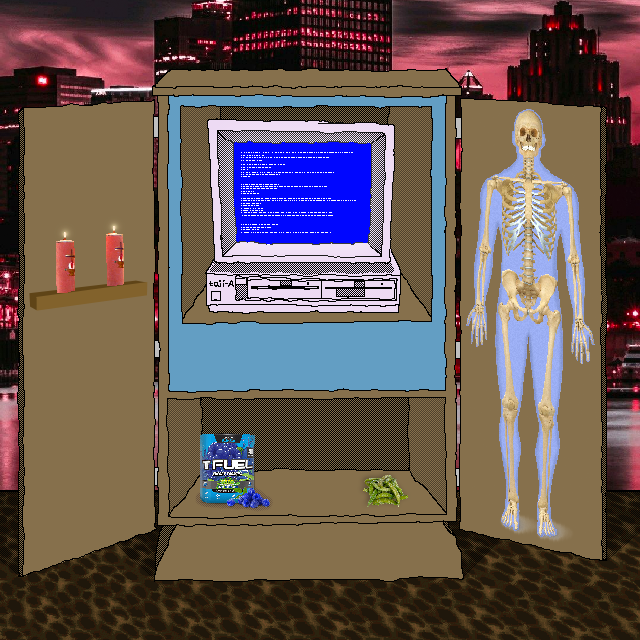
L: Your new collection, ‘The Same Old Gag’ fits into a recent trend in NFT works being about space: you present a set of often blank gallery walls, sparsely populated with the occasional painting, an arrow on the floor, a few loose ends, nothing. Obviously, your works have often been about space, Toji A being a prime example of this, but this new work is in deep contrast with the idea of traitmaxxing that is seen as core to the scene. I’m interested in this use of space, as well as your general thoughts and ideas that led to the conception of this collection, and how it got you out of NFT retirement.
TBM: I originally made [the images shown here] sometime in 2023. Post Toji-A I started to use this format occasionally to see how things might look on a wall, or in a space but also like something you could see in a video game. They are low-res enough to look real-ish but high-res enough to look uncanny. They become like scale / model works of art in a virtual dollhouse gallery. These images are like semi “traitmaxxed” versions of The Same Old Gag walls. I think putting myself in opposition to the traitmaxxing thing directly lead to Dogs which eventually led to this. I understand there is money to be made in derivative work, but it has a tendency to carry on way too long in these spaces. To the point where one project becoming more popular than an identical project is completely random, or is the direct result of some low level influencing. Unfortunately once it has fallen to that level it has already failed to become some sort of meaningful “art”. It instead becomes a trend and a scene and some kind of identity and product. It has no conceptual side. It’s flattened totally into a collage of signifiers and is an aesthetic mutation unbacked by any original idea or any thoughtful intention. Which is ‘good’ for opportunistic people who know how to profit off of it, and that clearly can create a good active market, but it gets really boring when people stop exploring even if it’s just aesthetic exploration. Especially coming from the days where every project seemed to be less about the image and more about weird promises and community building. Those are also typically bad and are most of the time executed terribly but the point is either trying something or taking advantage of new tools and their possibilities to push something forward. This played a role in my wanting to stop with Dogs. It seemed like a good time to leave and do something else as I was also (and still can be) caught up on images. I guess I came back and made this project because I saw the new interest, and I wanted to see what would happen with this idea. Maybe people would be receptive to something new. It worked surprisingly well. I thought it would flop for sure or even make people angry. The collection was originally going to just be the same image of the room with the only differences being Temperature and Atmosphere [traits, which you can only view in the metadata of the images]. That didn't seem good enough though when it was all done. It was too lazy and a waste of a potentially fun project so I started painting trash on the ground.


L: I have been bored of the pfp format for so long and I think the way you talk about derivatives is exactly why. I'm even somewhat bored of the 'collection' format and keep going back to being far more enamoured by 1/1s / physicals. What you’re saying here also goes back to a Tweet that fundamentally changed my idea of what a lot of people were doingwith NFTs, especially in lower level, derivative traitmaxxing works, and why it was falling flat: ‘"My art is a bunch of things that i like put together!" 👶’
What were you looking at that made you feel this way?
TBM: Hah I couldn't tell you. I think so much of it looked like that in 2024. I remember seeing things and thinking so this is an NFT for a guy that likes this music / anime and this is an NFT for a guy who likes a slightly different music / anime. There was and still is a real quantity vs quality problem. There's something intoxicating about making unfiltered moodboard collages for people but it's just like putting stickers on something. The weirder part of it is buying the NFTs becomes like buying someone else's sticker covered crap because you want everyone to know you like the same things too without going through the effort of sticking it all together yourself. One thing we tried to do with the Toji 100 was make the majority of them open or even vibeless and then make some assets for everyone. We didn't really have a market for them so we were just throwing a lot of shit out there. I don't think this problem is limited to NFT creators. You just see a lot of it in general. I just look at these things and I can't give a fuck about any of it. It's like you look at it for 30 seconds and you can see the entire vibe of it. You immediately can see how it was made. How could you not get bored. When you look at a spiky dj you're like how the fuck did they make this thing. How did they make the dj that way. How does he look like that. Same with a Jim Spindle NFT. You just don't even know what you're looking at because it's thoughtful and seamless. It's not using cheap tricks to appear visually confusing or fuller than it really is. Those are complete images and they're comfortable sometimes being empty. It probably has a lot to do with understanding space and some people just not being able to see the difference.


L: You talk of how projects never end; is this something you’ve felt regarding Tojiba as a ‘company’/identity? Do you want it to end, or do you hope we can all /work forever?
TBM: No, I think we keep a healthy distance from Tojiba and that kind of helps keep it alive. Doing anything too many times is bad for you and it's bad for your future and past projects. Just doing anything too much is crazy. I think we can all /work forever if we do it every now and then. That's more a warning against allowing the market or the holders to pressure you and take control of your project. And that resulting in becoming too much of a brand. Or in soullessly churning out garbage. It's susceptible to the same pitfalls as any other artform.
L: Outside of the current market interest that is swamping the Gay NFT scene, is there anything inspiring you to create now, and any future plans?
TBM: Nothing in particular I suppose. I'm always doing something. I'm excited to see what happens with NFTs. I always want to see more artists making interesting projects. Seeing more movements like cuckcore would be good. You can't really force anything though so you kind of just have to sit back and see what happens.
Footer: As always, thank you to Exchange Art @exchgART and @bonk_inu Art Masters for helping me to publish this interview.
Thank you to Tojiba Brand Manager @m_m_____m____mm for taking his time to answer my questions.
All links relating to this article will drop a little later, thanks for your patience! In the meantime, easiest place to get more Tojiba info is here: https://tojiba.biz
· · ·
Added Sep 30, 2025, 3:32 AM
deffo gotta make it happen <3 ty
· · ·
Added Sep 30, 2025, 4:10 AM
100000%
thanks for reading 🫶
Thread by @archivepilled · 15 tweets · Tuesday, September 30, 2025 · Archived via ThreadPilled · Original