Surrealism 1.0: a brief historical reference
Surrealism emerged just over a century ago, in the aftermath of the First World War, when many blamed rationalism for the devastation that had unfolded. Around the same time, Sigmund Freud’s psychoanalysis introduced the notion that beneath reason lies a powerful subconscious realm, governed by desire, repression, and irrational impulse.
Drawing on Freud’s ideas, a group of artists and thinkers began to question the supremacy of reason. They argued, in essence: look where rationality has brought us—it’s a terrible place. Instead of logic and order, they turned their attention to the irrational, the subconscious, and the world of dreams. There was method to their madness: to reach the mind’s darker, ungoverned spaces, they practised free assosiation and automatism—a way of creating without conscious control, allowing the subconscious to dictate form and meaning. Politically, the Surrealists were connected with Communists and Anarchists.
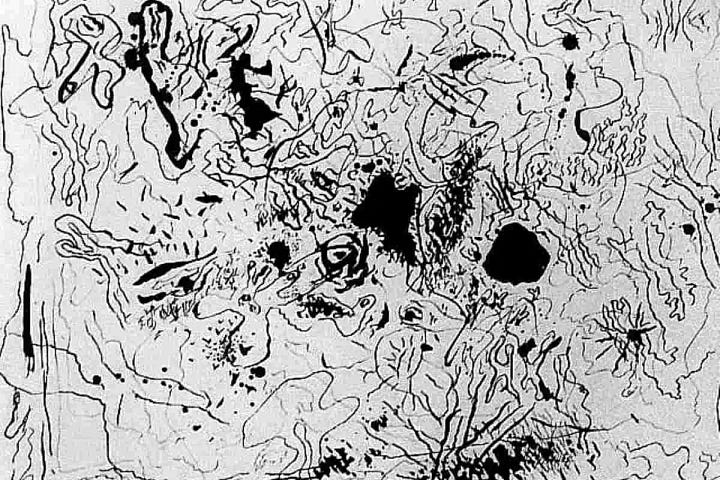
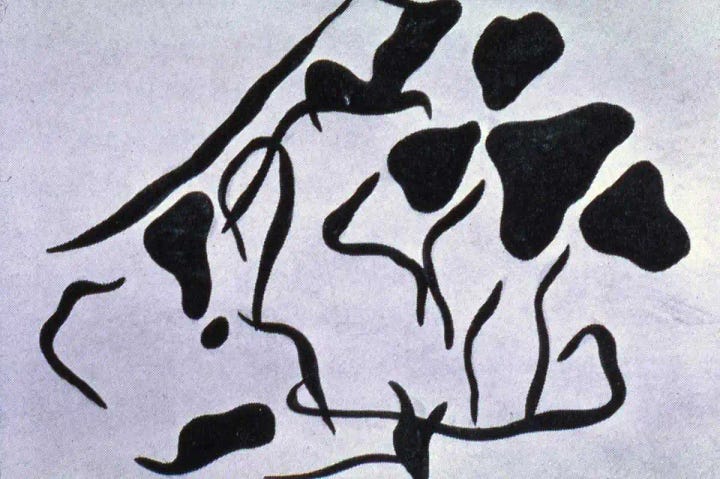
Automatic drawings by Salvador Dalí and Jean Arp
The movement was formally established in 1924, when Breton published the Surrealist Manifesto. This was a time of profound upheaval, as revolutions, civil wars, and other seismic events reshaped Europe. Empires collapsed. The dreams of that period were, in truth, nightmares. Out of these nightmares emerged the now-familiar Surrealist iconography: distorted bodies, improbable juxtapositions, impossible perspectives—images deliberately unnatural, designed to provoke, often with some unsettling undertone.
This overreliance on visual contradiction played a cruel joke: once the initial shock wore off, the viewer was left with an easily reproducible, decorative imagery that quickly slipped into kitsch. Later, as the movement’s psychological and political depth was forgotten, only its surface endured—dreamlike, irrational, vaguely erotic, yet stripped of context. It is far more difficult to shock a twenty-first-century viewer, oversaturated by images and visual noise, and so Surrealism gradually lost its zeal.
Though I should be fair to Dalí—Warhol thought we’d each get fifteen minutes of fame; Dalí predicted we’d drown in absurd, indigestible nonsense, for far longer than that.
Surrealism 2.0: many happy returns
A century later, Surrealism has re-emerged (oh shit). Historically, this revival owes much to Cecilia Alemani’s Venice Biennale The Milk of Dreams—a title borrowed from Leonora Carrington’s book—which revisited the movement through a feminist lens. At the same time, artificial intelligence’s inability to render the human body correctly echoed the visual language of early Surrealism.
However, there is another, deeper reason for this comeback. A century later, the world is once again marked by instability, fear, and moral exhaustion. The number of catastrophic events may be smaller, yet our awareness of them is constant and inescapable. We can watch, in real time, the bombardment of cities, the suffering of civilians, and the political hypocrisy that sustains wars. It is difficult to remain sane when you realise your taxes finance the weapons that perpetuate conflicts you wish did not exist—and there is barely anything you can do about it. These are the same conditions under which Surrealism first emerged: when reality becomes unbearable, and when humanity—having believed that progress and reason had secured stability—faces its own disillusionment. When the mind can no longer bear reality, it seeks refuge.
From my own experience, many artists and viewers have turned to Surrealism once again. Yet the term is now used so loosely that it has almost lost its meaning: anything that departs from realism — an imaginary landscape, a dreamlike scene, a place that doesn’t exist — gets labelled “surreal.”
But Surrealism, as I’ve said before, was never just about unreality. It was a political and social movement: Surrealists wanted to change the world, not simply paint elephants on mosquito legs. It had a method for creating from the subconscious, and it developed a distinct visual and psychological vocabulary. It looked insane, but this insanity was pragmatically calculated. Today, when artists call their worlds “surreal,” what they usually mean is “invented.” (Indulge the generalisation: there are artists whose practice—at least visually—can be considered Surrealist, and others who analyse their dreams and pursue a coherent inquiry into the subconscious, but describing trends requires some degree of simplification.)
This contemporary “Surrealism” is safe. It is escapism stripped of intensity, of danger, of visual shock—and again, when reality is so unbearable, who can blame artists for wanting to retreat into a peaceful universe? But whether “true” or “false,” I’d argue that the staged theatricality of Surrealism is no longer the right visual language to express the confusion and disillusionment of the twenty-first century. Randomness is.
Surrealism 3.0: but can we just call it gay?
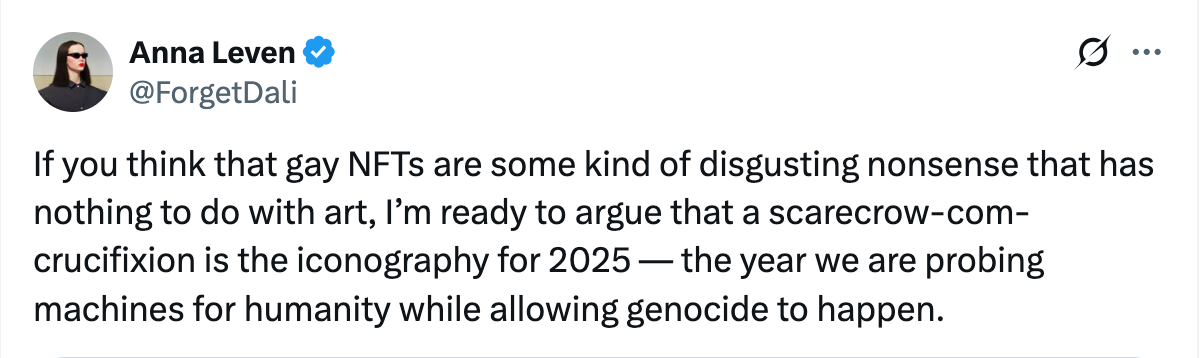
And this is where avant gay or schizocollage enters the picture. I use these terms because they are already established within the digital art community, though, like many people I’ve spoken with, I’m not entirely comfortable with them. Still, I have argued before that this visual language represents the proper iconography of our time — and I will explain why.
[
](https://substackcdn.com/image/fetch/$s_!A-v6!,f_auto,q_auto:good,fl_progressive:steep/https%3A%2F%2Fsubstack-post-media.s3.amazonaws.com%2Fpublic%2Fimages%2F55bfe42d-34ad-4108-af66-bf847b5adfee_1200x358.png)
These chaotic, layered compositions come from the same mental state as the original surrealists — a mind overwhelmed by trauma — but the trauma now is informational. We are bombarded with news, images, and stimuli every second. The scale of suffering that reaches us is unbearable. The mind cannot process it. To protect itself, it distorts, abstracts, and blocks.1 And beyond being unbearable, it just doesn’t make any sense – why all this cruelty?
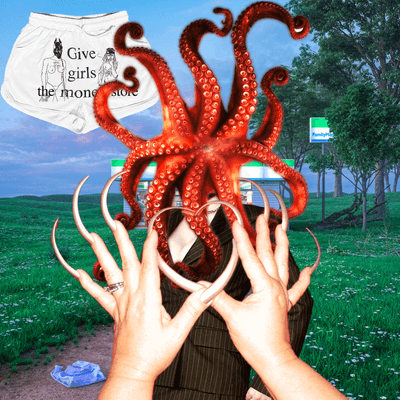
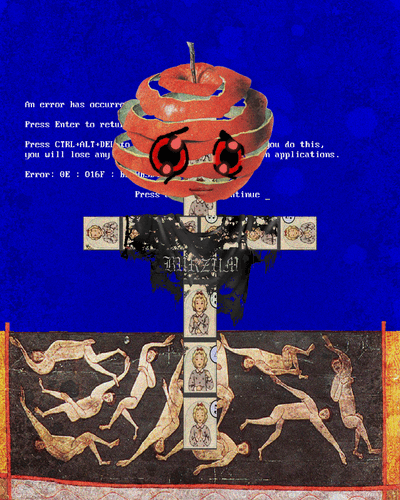
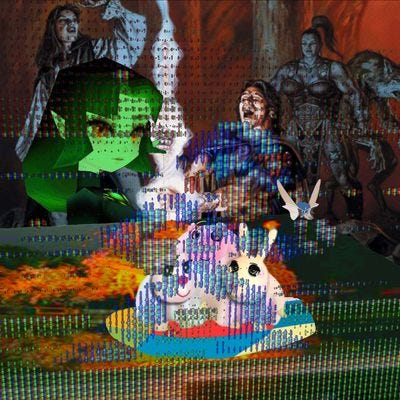
MeanGirlZ, Scarecrow, PiFella 2 Parasite Chamber – several examples of gay NFTs
To me, avant gay is the visual form that emerges from this condition and embodies both external chaos and mental confusion: randomly arranged, overlapping layers; visual overload; pop imagery; geek references; and a deliberate rejection of aesthetic refinement. Improbable juxtapositions are no longer staged—they occur through PFP-style trait generation, by chance, somewhat tweaking the role of the artist. Adrian Pocobelli, in his latest Artistic Journal, described avant gay as having “challenging aesthetics,” which captures it precisely. The same resistance to polish extends beyond maximalist collages that are associated with Solana and VVV: many artists on Tezos consciously turn toward the chaotic, the abrasive, the visually dense—or, conversely, the childlike and deceptively simple.
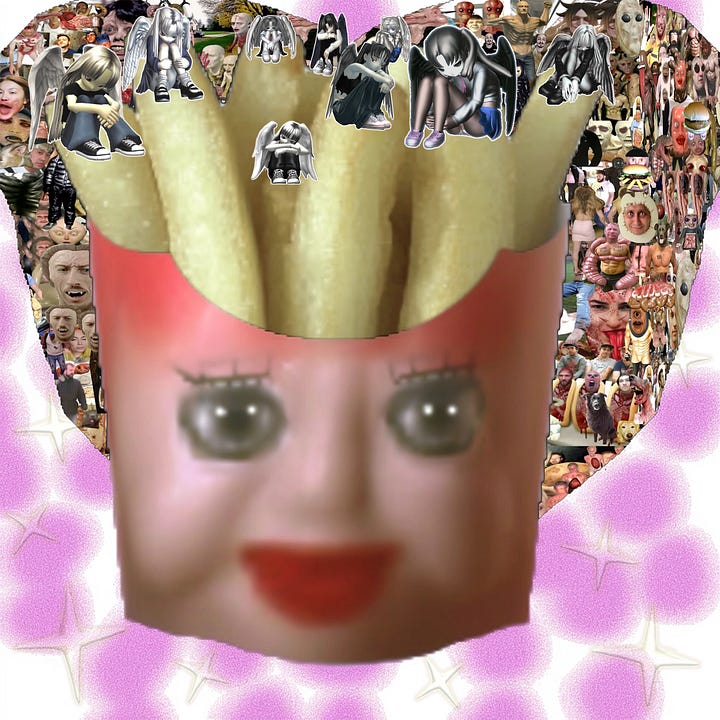
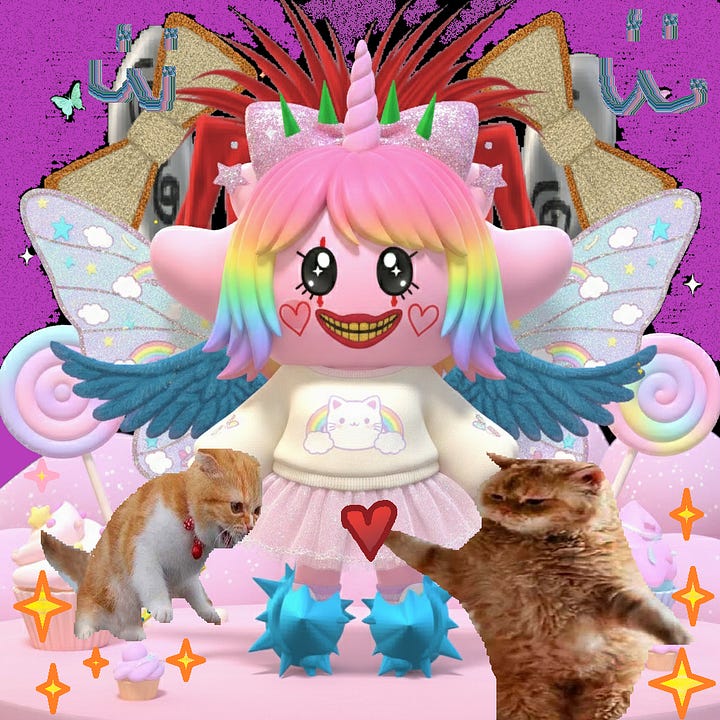
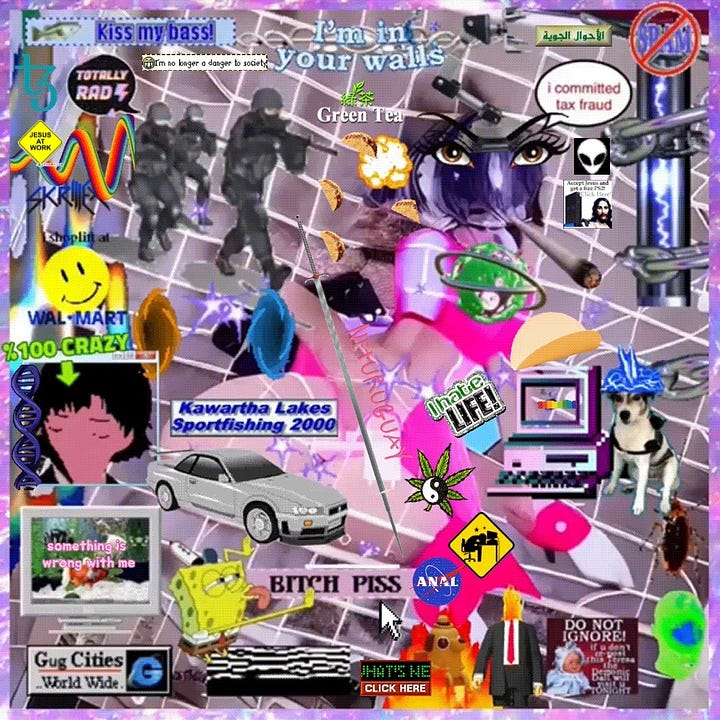
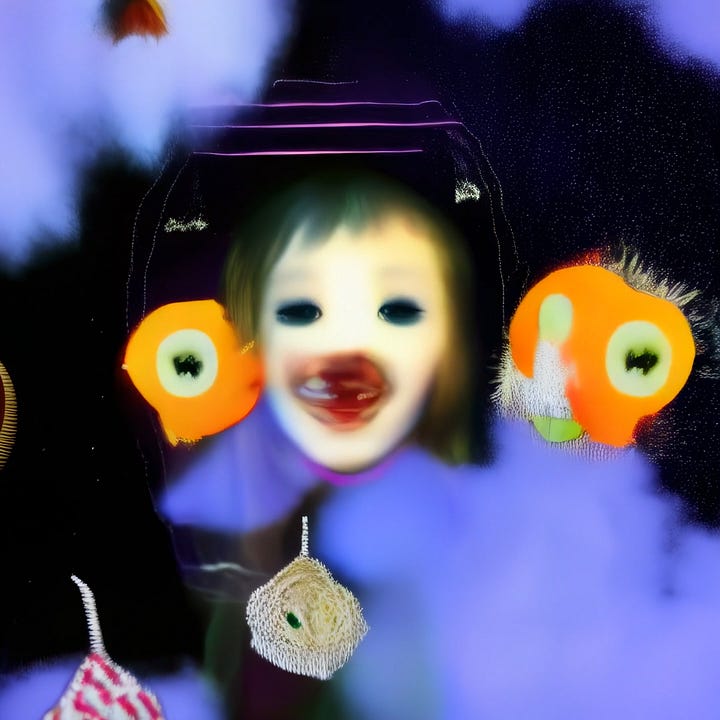
no hygiene: Fried potatoes with angel sauce; moesh1t: silly silly joy joy; agiisu + guruguruhyena: ꜱ.ᴡ.ᴀ.ᴛ//Sandwich.Weapons.And.Terrors; LittleCakes: I vomit wonder (still from a video) **I usually ask for permission to use the images, but this time I didn't contact artists as my son got sick – if you are not ok with me using the image, please write me and I'll remove it immediately
For me, to qualify as Surrealism 3.0, a work must deliberately fall outside conventional aesthetics—because it can be an overloaded collage and still remain harmonious—and make the viewer stumble over its apparent nonsense. It should function almost as shock therapy, forcing a pause, a question: What is happening here? Why is it so complex/so simple/so ugly/so naive? That moment of confusion—that what the fuck reaction—is precisely where its power lies.
These works mirror our fractured, overloaded, perpetually online psyche, contradictions that define our time, and our inability to make sense of what we see. They lack pretence, and that frankness is refreshing in contrast to the lulling escapism and ethereal beauty of so many other works piggybacking on the resurging popularity of Surrealism. (I also prefer them visually).
Whether this constitutes a movement is an open question, but challenging aesthetics may well be the defining language of our era. Can a movement be defined purely by its rejection of aesthetic harmony? Maybe yes, maybe no — but probably yes; there are precedents. Bad Painting deliberately rejected polish, technical virtuosity, and aesthetic hierarchy, proclaiming its disdain for prevailing styles and its resistance to commodified “good taste.” The artists (Neil Jenney, William Copley, Joan Brown, among others) weren’t painting badly out of lack of skill — they were painting “badly on purpose,” exposing the absurdity of art-world decorum. The parallel with avant gay and “new challenging” is clear — even if we still don’t quite know what to call them.
I’ll end this essay abruptly — my son got sick, and I won’t be back to writing for a few days. I’d rather wrap it up today and continue in Part 2, where I’ll look more closely at avant gay and the “new challenging” artists emerging across Solana and Tezos. In the meantime, I’d love to hear your thoughts — what should we call them?
I wrote about it a bit in this tweet